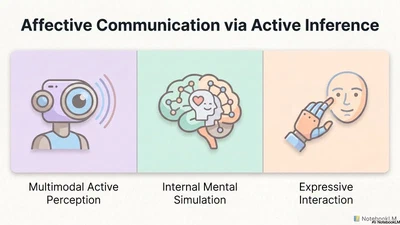
Affective Communication via Active Inference
Based on active inference and the free-energy principle, we computationally model multimodal affective communication between robots and humans. Integrating …
What underpins the workings of the human mind — emotion, consciousness, and creativity? We approach this question through a constructive approach that combines computational models and robots: understand by building.
Using predictive coding, active inference, and collective predictive coding as theoretical tools, we investigate how emotions develop through bodily and social interactions, how social reality is shared, how creativity is driven, and how qualia and consciousness can be understood as information structures — through computational models, robots, and multi-agent simulation. The research is organized into four sub-areas: Computational Models of Emotion, Computational Models of Social Reality, Computational Models of Creativity, and Qualia and Consciousness.
Based on active inference and the free-energy principle, we computationally model multimodal affective communication between robots and humans. Integrating …
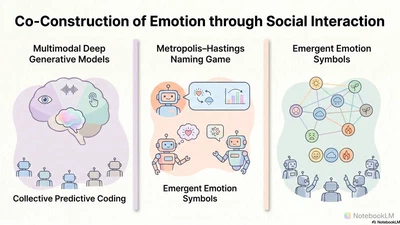
We computationally model the process by which multiple agents co-construct emotion categories through social interaction, using collective predictive coding and Metropolis–Hastings …
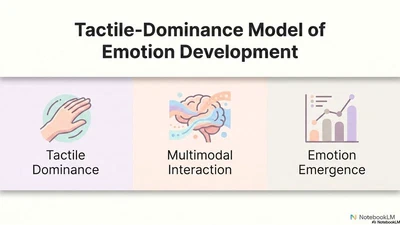
Focusing on tactile dominance in infancy, we computationally model how emotions differentiate and develop through multimodal (visual, auditory, tactile) interactions. Using …
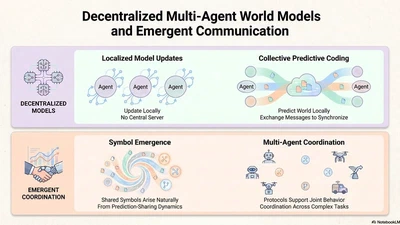
Building on the framework of collective predictive coding, we computationally model how multiple agents can learn world models in a decentralized way while emerging communication …
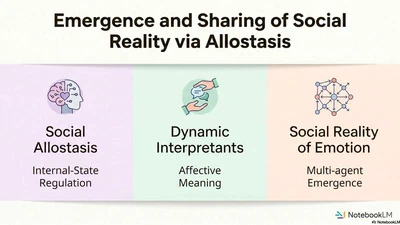
Based on allostasis (predictive regulation for maintaining homeostasis) mediated by social communication, we computationally model how the “social reality” of emotion emerges and …
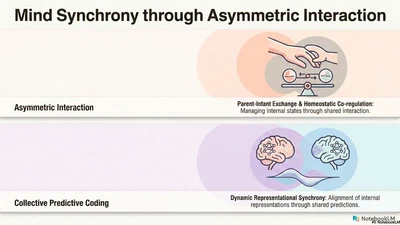
Using asymmetric social interactions — exemplified by parent-infant exchanges — as the subject, we computationally model how mind (internal-representation) synchrony is established …
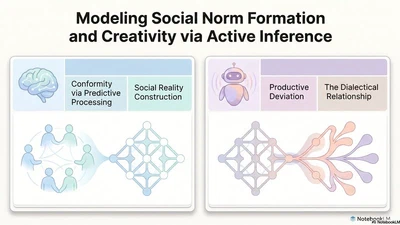
Using active inference as a unifying framework, we computationally model how social norms form and are maintained through agent interactions, and how the same predictive processing …
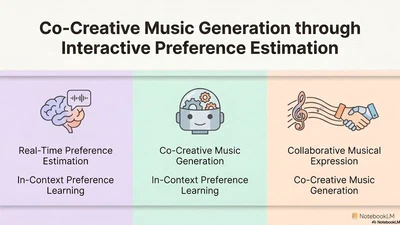
We study co-creative music generation that estimates users’ affective preferences on the fly through dialogue and reflects them in diverse creative suggestions. Using In-Context …
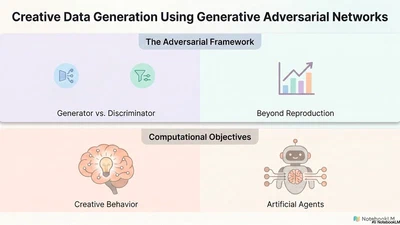
Using generative adversarial networks (GANs), we propose a framework for creative data generation that goes beyond mere reproduction of training data. Through the adversarial …
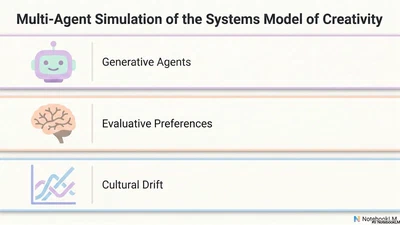
We implement Csikszentmihalyi’s systems model of creativity (the interaction of individual, field, and domain) as an in silico simulation by multiple generative-AI-driven agents, …
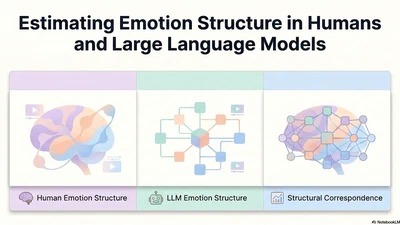
We compare the high-dimensional emotion structures elicited by video stimuli in humans and in multimodal large language models (LLMs), computationally elucidating their …
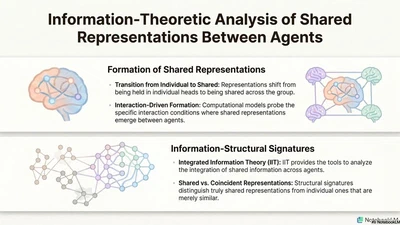
We analyze the structure of shared representations that multiple agents acquire through interaction, using information-theoretic approaches including Integrated Information Theory …
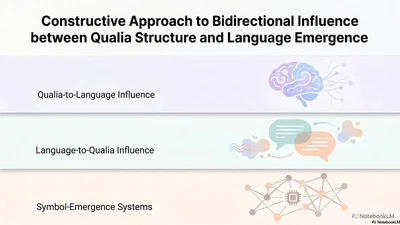
We constructively investigate the bidirectional influence between the structure of subjective experience — emotion and qualia — and the emergence of language among populations of …