Mind Synchrony and Emergence of Social Reality through Asymmetric Interaction
2024年1月1日
·
1 min read
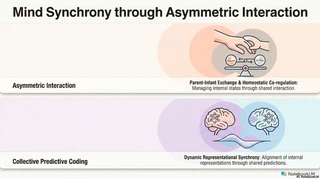
Using asymmetric social interactions — exemplified by parent-infant exchanges — as the subject, we computationally model how mind (internal-representation) synchrony is established through collective predictive coding, and how social reality emerges from it. Grounded in constructive theories of emotion, we explore mechanisms of dynamic representational synchrony through homeostatic co-regulation.
Related papers:
- Yushi Tsubamoto, Shoichi Shimada, Takato Horii. “Synchronizing Minds through Collective Predictive Coding: A Parent-Infant Interaction Model Based on Constructive Theory of Emotion” (in Japanese). 43rd Annual Conference of the Robotics Society of Japan, September 2025.
- Yushi Tsubamoto, Takato Horii. “Dynamic Representational Synchrony through Collective Predictive Coding: A Computational Model of Parent-Infant Homeostatic Co-Regulation”. arXiv:2605.07524.

Authors
Takato Horii
(he/him)
Associate Professor
Associate Professor at Graduate School of Engineering Science, Osaka University.
Research interests include cognitive developmental robotics, computational modeling
of emotional development, and human-robot interaction.